Showing posts with label Katyanne Shoemaker. Show all posts

Thursday, September 27, 2018

Challenges faced by women in science

English edit by Katy Shoemaker


A debate at the Institute for Advanced Studies (IEA-USP) recently got my attention, entitled “Women in the University and Sciences: Challenges and Opportunities. If you can understand a bit of Portuguese, it is worth watching the entire video (it is only available in portuguese). The debate lasts around an hour and consists of three female scientists telling incredible statistics and surprising facts about women’s participation in the academic world, and some of these facts are really hard to believe.


So this week, I want to discuss some of the facts included in this debate. To do that, I searched for more data so we can go deeper into the subject. First of all, I was happy to find out that women represent about 50% of the undergraduate students in Brazil. We are even the majority in some areas. However, when we look only at the sciences and engineering, women make up less than 40%. At the University of São Paulo, USP, a paltry 15% of the students enrolled in engineering courses are female.


Extending beyond undergraduate education, there are also as many women as men in graduate and postdoc positions in Brazil. In fact, in 2010, more women earned Masters and Ph.D. titles than men. But again, that is not the reality in science and engineering. There is still something hampering our inclusion in these areas, including oceanography.
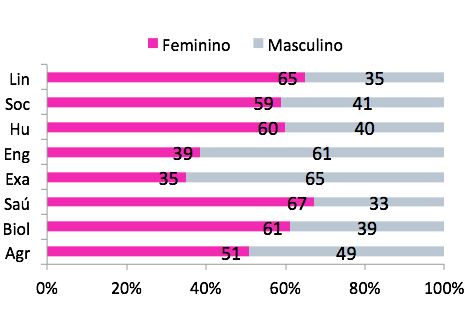

Number of scholarships per area in 2014. Source CNPq. Women: Feminino; Men: Masculino.


The most shocking numbers are those related to the distribution of specific research grants called PQ grants. These grants are awarded to researchers for research excellence, and they determine the distribution of funding to research projects in the country. Therefore, PQ grants directly affect our performance as researchers. PQ fellowships are tiered, and women's participation decreases as we go up each level. Note that women receive no more than 38% of these grants, even at the lowest level.
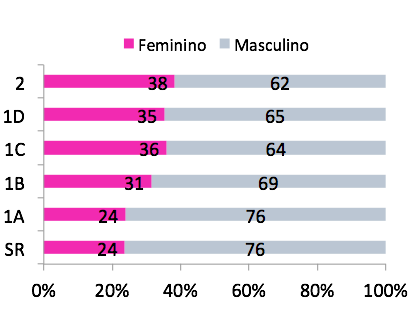

PQ research grants per level in 2014. Level 2 is the lowest category that a researcher can apply for, whereas SR is the highest level. Source: CNPq. Women: Feminino; Men: Masculino.

It is clear from these two plots that there is both horizontal and vertical segregation of men from women. Women appear to be concentrated in certain careers (horizontal), but within a career, there is a vertical separation of power, with women having low representation in the highest positions.


We find more examples of vertical segregation when we analyze leadership positions in large research groups. In Brazil there are currently 126 National Institutes of Science and Technology (INCTs). Well, 109 of those INCTs are run by men and only 17 by women. There are 6 INCTs focused on oceanography/marine science, and only one of those is lead by a woman (Antarctic Environmental Research - INCT-APA).


An all too common scenario can be seen in the Brazilian Academy of Sciences (ABC). The following data was presented by the physicist Carolina Brito (Federal University of Rio Grande do Sul) in the debate I mentioned at the beginning of this post. For a researcher to join ABC, he/she is nominated by an ABC member and a committee decides whether or not that researcher will enter. This committee is massively comprised by men, and as you can imagine, the result is not at all encouraging for female scientists. There is a list of the current ABC members on their website. There are 795 men and 122 women in ABC. From these, 15% of the men are below the 1A level in the CNPq, and only 1% of the women are below level 1A researchers. A fast interpretation we can make is this: if you want to be a member of ABC, and if you are a woman, it is almost mandatory to be a level 1A researcher or higher. For men, this standing does not have the same impact.


Unfortunately, this reality does not seem to be getting any better. In 2008, 20% of the deans in universities were women, and 8 years later, this number dropped to 10%. Although 48% of the Ph.D. holders are women, only 23% of them occupy teaching positions in our public universities. In a previous post we have addressed some of the reasons for why women quit the academic career at a higher rate than men (When to add children to the academic timeline).


So, what can we do to change that picture?
1 - The data presented here is limited. We need numbers, we need more indicators.
2 - We need training on gender issues. In France, curriculum was recently modified to discuss gender in all undergraduate courses. That sounds like a good start.
3 - We need to fund women's projects, provide scholarships, and reward them. We have very few initiatives, but these have incredible effects. Check out the post Finding self-confidence as a woman in science to see Deborah's testimony on the importance of being recognized in her area.
4 - We need role models. Young female scientists do not see people like themselves in power positions regularly enough. Socially, girls are still discouraged to pursue scientific careers that are considered "hard." From a very young age, we are overwhelmed with ancient cliches telling us how to take care of the house, how to be good wives, mothers, true ladies of our homes. We have to give girls the opportunity to fall in love with science and make them confident that this relationship can work. The L'Oreal Foundation recently conducted an opinion poll that demonstrated how Europeans feel about the role of women in science. Five thousand people were heard (men and women), and 67% said that women are not qualified to hold positions of high responsibility. The main reason being that "women would suffer from lack of perseverance, lack of practical spirit, scientific rigor, rational, and analytical spirit."


All I have to say about this is: It’s time to get to work! At the VII Brazilian Congress of Oceanography there was a round table discussion on the subject, with a crowded room of people eager to speak. Although it was an excellent experience, there is still so much to discuss. So I want to invite you all to continue this discussion. Let's talk about gender in the spaces we occupy, spread this idea! Organize an event and call everyone you know. Share your experiences with us!


References on statistics:


Thursday, August 23, 2018

Misadventures in Research

By Yonara Garcia
English edit: Lídia Paes Leme and Katyanne Shoemaker


Illustration by: Caia Colla 

   As I was finishing writing my thesis, I started to consider all of the challenges that I went through in the two years of my Masters education in order to deliver such a perfectly rounded piece of work. My feelings were mixed because I was obviously happy to finish this step in my life, but I realized that this document didn’t contain even a third of all the misadventures that got me to this point. In my opinion, the thesis was missing a chapter; there should have been a chapter on “the making of” the research, just to explain how much went wrong and what it really takes to deliver good work. 

   When starting a Masters course, you must submit a proposal, which includes your research objectives, the hypothesis, and how you plan to answer that hypothesis. Wow! It was so easy so far! You just follow a previously described method and you understand what your results will look like and how they should be treated. This is all based on previously done work on a similar subject, which of course you know all about after reviewing the relevant literature. Two years to finish this project? No problem! …or at least that is what I thought. For me, it was not this easy, so I am going to tell you a little bit about my many misadventures during my masters.

   My work was a behavioral study of marine planktonic organisms in a 3D system. To build the system, I got together with a crew of post-graduate students who would also be using the experimental tank. This is where the soap opera began. We believed that we could build our system based on previous studies, but we quickly noticed that several components were not correct. There were issues with the magnification, color of LED lights, and the shape and positioning on the table. Everything had to be disassembled and reassembled to incorporate the necessary changes. The entire system had to be rebuilt 4 times because with each assembly we noticed new flaws. After months of arranging and rearranging pieces, and with the help of specialists in the area of optics, we finally reached a working system. 

   Ok, that took a few more months than expected, but now I could finally perform my tests, generate results, and graduate, right? Wrong. My work required filming the trajectories my target organism takes in the water column. However, the software for the two cameras we had would only film for 20 seconds at a time, which was not a long enough time span to get a valid representation of swimming behavior. We increased the computer’s memory, but that was not the issue. Thankfully, a student in our lab was proficient with computer science, and he became a key contributor to this project’s success. The filming software was completely replaced with software he developed. This new program didn’t have a time limit, however it could not utilize two cameras at once, so two computers had to be used. Having the two computers meant we could be introducing human error in timing; no matter how hard I tried, I cannot click the mouse at the exact same time on two computers. The solution for this problem was to use two microcontrollers that were activated by a potentiometer. Finally, we had a working system with a program that could be modified according to our needs!

   Onto the experiments! One of the primary challenges of working with living organisms is that you depend on them to be present in a certain collection spot at a given time of year. Unfortunately for me, by the time the experimental system was set up, we could not find enough individuals to run the experiments. It took several months of daily sampling to have enough individuals to perform all of my experiments, but I finally finished. 

   After video collection, the next step of the project was to use a computer program to find coordinates and relevant numerical data on the trajectories of the organisms. Given the topic of this post, it may not be a surprise to say something went wrong in this part too. As it turned out, the program that was originally going to be used could not compare the long videos that we fought so hard to attain. Once more, we turned to our computer science hero, and he developed software that could give us the organisms’ trajectories independent of video size. Let me take a moment to point out that software development is not an easy task; it took several iterations to get it to the point we needed it.

   With data in hand, I could finally analyze them and get my results. Data analysis is never easy, but given what I had already gone through, the challenges seemed minor in comparison. I had no idea how far off that initial Master’s plan would end up being, or that I would face so many challenges. I also didn’t expect how much this project would shape me. I had to be more than a biologist for this work; I learned how to solder, make electrical connections, understand physics, be a computer technician, and learn a little about programming. 

   Beyond all of the research obstacles, you still have to live your own life. This may be the most complicated part of the whole project. I often felt defeated and like I couldn’t carry on as I was faced with problem after problem. I know many others have lived through much bigger issues with their graduate research, but no matter the size of the problem, it shakes you to the core, and it can often be debilitating. 


   But, if you can push through these setbacks and fears of failure, you will eventually reach the end with a huge sense of accomplishment, as I did. It is important for me to share these misadventures in research with you to show what it actually takes to do research—it involves many tries and more wrongs than rights, but in the end, you publish a beautiful piece of well-crafted work. Even with all of the pressures and obstacles I faced, I still love what I do. Through all of the challenges, I grow more certain that I made the right choice.

   What challenges have you faced in your research? Comment below to share a little of your story with us!


Thursday, July 12, 2018

POP(s) – and we are not talking about a music genre

By Juliana Leonel
English edit: Katyanne M. Shoemaker

Persistent organic pollutants, commonly known as POPs, are a group of compounds that are very resistant to degradation. These compounds bioaccumulate, can be transported far from their source through atmospheric and oceanic currents, and can have adverse impacts on living organisms, including humans.


In 2001, representatives from various countries signed an agreement called the Stockholm Convention with the aim of reducing and controlling the production and use of POPs. This treaty went into effect in 2004 with 151 signatory countries. Initially, 12 compounds were classified as POPs, and the participating countries agreed to ban the use of nine of them. Additionally, the use of DDT (we have a post on DDT here) was limited to only malaria control, and the unintentional production of dioxins and furans was to be reduced.

The first 12 POPs were all organochlorine compounds (organic compounds formed by C, H, and Cl), which were divided into three groups according to their use and production. The first group consists of pesticides and herbicides: compounds used to fight agricultural pests such as insects and weeds, which are harmful to the production or storage of grains, fruits, vegetables, wood, etc. The second group includes compounds used in industrial processes, such as polychlorinated biphenyls (PCBs) that were mainly used to cool engines, generators, and transformers. Finally, the third group consists of the dioxins and furans, which are compounds unintentionally produced by some industrial processes. This third group contains  by-products of processes (e.g. metallurgy and steel manufacture) and are not produced for a specific purpose. Over the years, during the Conference of the Parties, another 17 compounds or groups of compounds have been added to the list of POPs.


From left to right: o,p'- DDT, cis-chlordane, PCB 153, perfluorooctane sulfonate, PBDE99


To deal with each of these compounds, they were classified into three annexes. Annex A: compounds that must have their use and production eliminated; Annex B: compounds whose use and production should be restricted and only allowed in specific cases; and Annex C: compounds in which (unintentional) production must be controlled and, where feasible, must be phased out.

Each signatory country is responsible for carrying out inventory of stocks, production, and use of POPs in its territory. In addition, these countries must implement measures to reduce or eliminate the release of both intentionally and unintentionally produced POPs. In some cases, it is possible to request an exemption, to use one of the POPs in exceptional cases for a pre-determined amount of time (Ex: DDT use in case of malaria infestations). Signatory parties are also responsible for conducting systematic monitoring studies to assess whether measures are being effective in reducing the environmental levels of POPs.

Brazil approved the Convention’s text through Legislative Decree No. 204 on May 7th, 2004, and promulgated it via Decree No. 5472, on June 20th, 2005. Implementation of the Convention in Brazil is coordinated by the Ministry of the Environment (MMA) through the Secretary of Water Resources and Environmental Quality.

Although POPs are mainly used on land, their transport to the ocean is quite effective, whether through atmospheric transport, urban drainage, or effluent released directly into coastal regions. In this way POPs have been detected in a wide variety of environments and animals (water, air, soil, sediment, birds, fish, marine mammals, etc.). They have been found at the peak of great mountains and in the depths of the oceans, from the equatorial region to polar regions (see an example here: http://batepapocomnetuno.blogspot.com.br/2017/05/pesticidas-e-aves-marinhas.html).  POPs are a not-so-subtle reminder that environmental contamination has no borders, and it is a problem and responsibility of all the world’s citizens. 


Stockholm Convention Text:
http://www.mma.gov.br/estruturas/smcq_seguranca/_publicacao/143_publicacao16092009113044.pdf
Stockholm Convention - Brazil - MMA
http://www.mma.gov.br/seguranca-quimica/convencao-de-estocolmo
Stockholm Convention Home Page:
http://chm.pops.int/


Friday, June 22, 2018

Big Bang to the Dawn of Life: A Brief History - Part II and III


Part II: Ideal conditions for the origin of life (as we know it)


Artist's conception of early Earth. Font
Earth's first 400 million years were hostile and desolate: temperatures of over 200 oC liquefied the crust, and volcanic gases, especially CO2, were released in large quantities into the forming atmosphere. As the Earth cooled, the crust solidified and the lower temperature allowed liquid water to remain on the surface. This cooling was a key factor in the emergence of life.
In addition, organic molecules, generated in the nebula that gave rise to our solar system, underwent chemical reactions. This resulted in more complex organic molecules, composed especially of Carbon, Hydrogen, Oxygen, Nitrogen, Phosphorus and Sulfur. These were the building blocks for the first biological molecules.
Another important event that allowed the development of life was our planet’s impact with a celestial body the size of Mars, which resulted in the formation of our Moon. It is curious to think that a collision with 100 million times more energy than the impact that killed the dinosaurs was pivotal in the establishment of life on our planet. The gravitational force of the newly formed Moon stabilized the incline of the Earth's axis. Without this stability, major climatic changes would occur, and complex life forms would likely not have developed.

Origin of the Moon: Artist's conception. Font
Other features of our planet were also fundamental to the emergence and maintenance of life, including the presence of a metallic nucleus, which generates a magnetic field and acts as a protective shield against cosmic radiation. Additionally, the presence of a mantle and its movement below the crust promotes tectonic activities such as volcanism and continental shift. Volcanism was very important in the emergence of life, since its gaseous emissions provided the compounds (CO2, H2S, etc.) that may have been used for energy by the first unicellular organisms. Volcanoes also help maintain the planet's climate and help recycle carbon back to living organisms.


Part III: Our chemical origins: the formation of biomolecules

An incredibly rare set of conditions (see Part II) allowed life to arise on our planet from organic molecules and chemical reactions. Today, all of Earth’s living organisms are composed of biomolecules such as proteins, nucleic acids, polysaccharides and lipids.
These biomolecules consist of small units interconnected with one another, called monomers. The biomonomers that form proteins, nucleic acids (DNA and RNA) and polysaccharides are respectively the amino acids, nucleotides and monosaccharides. We now know that most biomonomers can be produced spontaneously when given the necessary conditions.

Miller-Urey experiment, 1953. Font
One of the first attempts to produce biomolecules in the laboratory was done by Stanley Miller and Harold Urey in 1953. They were based on studies conducted by Alexander Oparin and J.B.S. Haldane who suggested that biomolecules and life would have emerged in a “primordial soup,” an atmosphere rich in methane, ammonia, hydrogen, and water vapor.

The Miller-Urey experiment attempted to simulate these primitive Earth conditions described by Oparin-Haldane. In a sealed system, gases were introduced to create the primitive atmosphere described above, a heat source and liquid water were added, as well as electric discharges. Under these conditions, a number of biomonomers, such as the amino acids glycine and alanine, and other organic compounds such as urea and formic acid were produced.
Although recent studies indicate that the composition of the primitive atmosphere was not exactly as Oparin and Haldane proposed, the importance of Miller-Urey's experimental results revolutionized our concept of the origin of life by solidifying the idea of a chemical origin for all living organisms.

Types of biomolecules. Font

The next step in the emergence of the first living cells was the polymerization of these small structural biomonomers. How did  amino acids, monosaccharides and nucleotides form protein chains, polysaccharides, or the complex structure of DNA and RNA? Unfortunately we still do not have all of the answers to these questions, and the hypotheses that have been developed are difficult to test.
An important question when discussing the origin of life is how these biomolecules clustered together to form the first living cells capable of carrying genetic information and reproducing themselves. This is also a question that still challenges science, but many researchers are exploring new ideas that may explain the great leap from an essentially chemical world to a biological one.

Genetic information flux. Font

One of the first steps of this great leap is to understand how a nucleic acid molecule has the essential role of storing information that can be transmitted to subsequent generations. One of the most accepted hypotheses for the origin of genetic information is that of the RNA world, which suggests that RNA arose before the DNA molecule. However, in living organisms today, the flow of genetic information begins with DNA. Why then, would the first cells or proto-cells have RNA as the main source of genetic information?
DNA in today's cells require a complex machinery of proteins to be replicated. These proteins, in turn, require a DNA molecule that carries the information for later translation. Thus, the dichotomy of which originated first, DNA or protein, makes this question virtually unsolvable.

RNA world hypothesis. Font
For this reason, many scientists suggest that RNA was the first informational molecule to emerge, as it contains two essential properties for the maintenance of a primitive cell: a ribozyme activity, which makes it capable of catalyzing its own replication, and a catalytic activity capable of synthesizing some proteins. We still do not understand how mutations in the RNA molecule gave rise to DNA or how DNA was subsequently selected as the main source of genetic information of the cells.

Another important step for the formation of the first living cells is the emergence of compartmentalization. All cells have a plasma membrane composed essentially of phospholipids that guarantees the protection of the cytoplasmic content. Compartmentalization stores the molecules inside the membrane, facilitating chemical interactions. In addition, the selective permeability of the plasmatic membrane makes the chemical concentration inside of the cell different from the concentration of the surrounding environment, a characteristic fundamental for many cellular processes.
Lipid compartments are spontaneously formed due to their amphipathic nature - just mix a little oil into a glass with water and soap and watch. On primitive Earth, the compartments likely formed around biomolecules and some constituents that eventually gave rise to the first forms of metabolism and cellular functioning.


You can access Part I here!


Friday, April 13, 2018

Big Bang to the Dawn of Life: A Brief History

By Amanda Bendia

English edit: Katyanne M. Shoemaker

Part I - Big Bang: the origin of atoms and explosion of stars
Fourteen billion years ago: from the singularity
 to the greatest explosion of all time, the Big Bang.
https://www.smithsonianmag.com/
smithsonian-institution/ what-astronomers-are-still-
discovering-about-big-bang-theory-180949794/
It is estimated that the number of species that inhabit the Earth currently exceeds 8.7 million.  Not included in this calculation are the bacteria and archaea, which are microscopic prokaryotes. These microscopic organisms are single celled and devoid of a nucleus and membrane-bound organelles. The number of species of these prokaryotic microorganisms, surprisingly, surpasses the estimated 8.7 million eukaryotic inhabitants of the planet  (eukaryotes have a more complex cellular structure with nuclei and membrane-bound organelles and encompass all animals, plants, fungi, protozoa, etc.). Such immense values make us reflect on how such incredible diversity may have arisen throughout the history of our planet and the Universe.
To begin to discuss this question, we need to go back 15 billion years ago, to a point where everything we now know was concentrated in one single point. Can you imagine this? All of the humans and all other organisms that have inhabited the Earth, all of the objects we have produce with our technology, all of the molecules that make up our planet, all of the atoms of the billions of stars that we have already detected in the Universe, all of the Cosmos, gathered in this singularity. And then, there was the biggest “explosion” of all time: the Big Bang.
The origin of our solar system:
the ingredients for the origin of life in a

 cloud of stellar dust.
http://www.abc.es/ciencia/20150115/abci

-otro-origen-sistema-solar-201501151033.html
The Universe expanded, cooled and darkened. The first atoms formed and their accumulation generated large clouds of cosmic dust that would give rise to the galaxies. Within the galaxies, the first generation of stars formed; within them, atoms fused, first of hydrogen, but then giving rise to heavier chemical elements. When the fuel was depleted, the stars exploded and released these elements, enriching the stellar gases.
A new generation of stars began recycling these elements, and even heavier atoms were formed. The accumulation of clouds filled with cosmic dust - the nebulae - gave rise to planetary systems, including our solar system. During the formation of planet Earth, approximately 4.5 billion years ago, organic molecules composed of carbon formed and created all of the ingredients essential for the development of life.

Wednesday, March 14, 2018

Water on Mars and the deep ocean

By Jana M. del Favero

English edit: Katyanne M. Shoemaker


   At the end of September of 2015, NASA scientists publically confirmed the existence of liquid water on Mars, the Red Planet (https://www.nasa.gov/press-release/nasa-confirms-evidence-that-liquid-water-flows-on-today-s-mars). I remember when this news was released and how it caused certain uproar over the possibility of finding life there.

https://lh5.googleusercontent.com/_YTuLWAELDa9xE8L7qc-YKguGnJyWCCgo6NyMjEPgxiT-5yulUtAq1Y3VPuXM41xvnlGiT03wPXiYbr4lwl5E0l3wG5v3SxfqhsQ6eIsshNlgxuGqTrcH-8p-ugkdI3ElieCCUfXjJYu44qM

Landscape of the mysterious Red Planet; from the movie The Martian (https://www.empireonline.com/movies/features/martian-trailer-breakdown/).


   We know that life depends on water: it is the largest constituent of every living being (e.g. the human body is composed, on average, of 60% water), it is necessary for photosynthesis, and it is indispensable for several other vital functions. However, the phrase just quoted neglects an important detail: life, AS WE KNOW IT, depends on water.

   This made me remember the following cartoon, about two giant tubeworms talking to each other:

https://lh5.googleusercontent.com/pBelO8MAJyRLCdEM0WkB4gU-dYzuLTlBH61D6a1TIH7Sol4-Pzte24gDfO9HHCD2La6QC_JoTXN9NKAPMsKkb-jyc_eyPsYKiWFgedc6DuzeTqNIStKfcO8lZUXmDNO2k6aa_d2MMNdJ-Na8
http://www.beatricebiologist.com


   I had posted this cartoon on my personal Facebook page previously, but then I reflected: how many of my friends know what giant tubeworms are? Or what hydrothermal vents are?


   Tubeworms are marine invertebrates in the phylum Annelida (yes, the same as the earthworms) and the class Polychaeta (aquatic worms), but they are sessile, i.e. they live fixed on an underwater surface. Their body is rounded by a tube, which extends the length of the whole body. The one illustrated in the cartoon are of the species Riftia pachyptila, popularly known as the giant tubeworms. These worms can live several kilometers down in the ocean, and they can reach a length of 2.4 m with a diameter of 4 cm. (more information on: https://en.wikipedia.org/wiki/Giant_tube_worm)


https://lh4.googleusercontent.com/Y5t9Qwb_9qCfTdqcjs0z1MB-ESA0JoJmPKroDm2X2qajOvAD4pKXO1rDOFsvSpLuLzw_JBzK8efEb30rFcqn1NUYuahvUCuXTckqZnGz-LW9QojR-A6QvAgyYo6lU-cLzCX2-SqAQKJW1t3v


   A hydrothermal vent is a fissure in a planet's surface from which geothermally heated fluid emerges. The water that penetrates the crust at deep depths reacts with the minerals present, undergoing physical and chemical changes along the way. Usually there is an “oasis” of life along the hydrothermal vents. This is due to chemosynthesis, a process in which microorganisms use chemical energy to produce organic matter from carbon dioxide. 

https://lh3.googleusercontent.com/Xt6tkOr7g_q81wBi_stCE9-XNl97CfFLI1oB1EjEycjnf1FrNbxJHYUxJDHJlbOeb075Jpl71ITIVL_KfX8ABwu8ryB14_5sYRUSYFIsKVsDJa4geN1GgcFENJ7AIdL8pab7CyS6-19oGPva


   Prior to the discovery of hydrothermal vents in the 1970s, the scientific community assumed that all life in the ocean depended on photosynthetic production, mainly produced by phytoplankton. Since photosynthesis depends on sunlight, it was like saying that all of the life in the oceans depended solely on the sun! The hydrothermal vents and the abundance of organisms that live around them proved the opposite.

   And that's the point I wanted to get to in this post: WE KNOW AS LITTLE ABOUT THE OCEAN AS WE KNOW ABOUT SPACE!

   We have explored around 1% of the oceans, and they cover 80% of our planet.(http://noticias.terra.com.br/ciencia/pesquisa/cientista-brasileira-conhecemos-pouco-mais-de-1-dos-oceanos,58d9a38790aea310VgnCLD200000bbcceb0aRCRD.html)Most of the ocean is only about 3 km deep, but Mars is about 60 million miles away from Earth! I am not saying that scientific exploration of space is not important, but I wish that the amount of money invested in space studies and the media attention space discoveries receive would also be given to the oceans. We know so little still, and yet they are so much more present in our lives.

Wednesday, November 8, 2017

The extraordinary life of whale carcasses in the deep ocean

By Joan Manel Alfaro Lucas

Translated by: Lídia Paes Leme

Edited by: Katy Shoemaker

This story starts in 1987, when, during an oceanographic expedition lead by Dr. Craig Smith (University of Hawaii), the research robot Alvin found a whale carcass on the ocean floor in Santa Catalina Bay, California, 1240 meters deep (Smith et al., 1989). This discovery reinforced an idea that had been suggested before, that even though whale deaths are common in coastal zones, many die in spots far away from beaches and sink down to the depths of the ocean.
The deep ocean covers 63% of the planet's surface and is considered the biggest biome on Earth. It is unique and extreme due to its low temperatures, high pressure, and darkness (light doesn't penetrate more than 200 meters below surface, where the deep ocean starts). The absence of light makes organic matter production via photosynthesis impossible. Because of this, the deep ocean ecosystem is limited in food sources and depends almost exclusively on the sinking of organic matter produced in the surface waters. In the vast, cold, dark deserts of the deep ocean known as the abyssal plains, the few organisms that survive there filter water and sediments to take in the little organic matter that sinks down from the surface.
So now what about that Californian whale that Dr. Smith found? The carcass was completely missing meat, and other indicators suggested the whale carcass had been there for several years. However, the skeleton and the sediment around it were bursting with life! There were worms, snails, gastropods, dense mats of bacteria, and bivalves such as clams and mussels. The carcass was a real oasis of life in the deep desert of the bay. The scientists began to understand that, for an environment so poor in nutrients, the arrival of a whale carcass is an extraordinary event.
Whales are the largest animals that inhabit Earth. The blue whale can be 30 meters (~100 feet) long and weigh 120 kilotons and is the largest animal that has ever existed on our planet. To the desert depths of the ocean floor, their carcasses are the biggest source of organic matter that arrives from the surface. One carcass from a 40-kiloton whale is the equivalent of 2000 years worth of organic matter falling down at once!

Image 1 – Whale carcass on the deep ocean floor of Santa Catalina Bay, California, densely colonized by chemosynthetic bacterial mats. Photo by Craig R. Smith, University of Hawaii, USA.

Some of the organisms found for the first time on the carcass by Dr. Smith became much more interesting when identified. For example, some bivalve species found there are known to have symbiotic relationships with chemosynthetic bacteria. Those mussels feed on the matter produced by the bacteria, a process similar to what shallow water corals have with photosynthetic organisms. As it turns out, the dense bacterial mats found on the carcass were of that kind of bacteria.
Similar to vegetables in the terrestrial environment, these chemosythetic bacteria form the base of the food chain in the deep ocean. Chemosynthetic communities feed on organic compounds, some of which can be abundant on the sea floor. This is the case in hydrothermal vents, which form in parts of the floor where volcanic activity is elevated and hydrocarbons flow from underground reservoirs (post about hydrothermal vents here). The bivalve species associated with the whale carcass were discovered for the first time at cold hydrothermal vents! These similarities suggested that the whale carcass acts as a trampoline for the common habitants of different chemosynthetic communities to disperse, as they are usually separated by distances larger than can be reached by larval dispersion (Smith et al., 1989).
This discovery, other than being revolutionary for the ecology of chemosynthetic communities, led several groups of scientists to research more about these ecosystems. Rather than looking for a carcass on the vast ocean floor (a real needle in a haystack situation), scientists started to sink dead whale carcasses with weights. They were able to sink them in a determined spot where they could sample whenever needed. After these experiments, scientists began to understand that not only chemosynthetic communities developed in the carcasses, but also there were extremely diverse and abundant communities that explored the carcasses in amazing ways… for almost a century!

Image 2 – Hagfish feeding on a whale carcass during the ecological state of the mobile necrophagous organisms in Santa Catalina Bay, California, USA. Photo by Craig R Smith, University of Hawaii, USA

The whale carcasses develop mostly three ecological successive states, meaning three communities can be distinguished throughout time (Smith et al., 2015). The first stage starts with the arrival of the carcass in the bottom and includes the mobile necrophagous organisms. Hundreds of animals, like hagfish, drill the meat while sharks bite big chunks off. These communities, similar to vultures in a savanna, remove several dozen kilograms by day and can consume all the meat in up to two years, depending on the size of the carcass.


Image 3 – Crabs, snails, and anemones colonizing the skeleton during the enrichment and opportunist stage in a whale carcass in Monterey Canyon, California, USA. Photo by the Monterey Bay Aquarium Research Institute. USA.

The second stage involves the enrichment of opportunists and can also last up to two years. During this period, high densities of worms, crustaceans, and other invertebrates colonize the sediment around the skeleton that was exposed after the flesh was consumed. These invertebrates feed directly on the left over fat and meat left behind by the necrophagous organisms, as well as the bones, which are rich in protein and fat.
The last stage, the one Dr. Smith's whale was in when he found it, is the sulphophilic stage. Some microorganisms are able to penetrate the dense bone structure and access the big quantities of fat remaining in the interior of the bones. These organisms use the sulfur dissolved in water to digest the fat, creating inorganic compounds as secondary products. Similar process can also occur in the surrounding sediment, which was impacted by the organic matter of the carcass. This creates enough of a flux to develop a community based on chemosynthesis. This is the longest stage, lasting up to 80 years.
The discoveries around whale carcasses don't stop there. Since 1987, when Dr. Smith studied the first deep ocean carcass, 129 new species have been discovered, many of them only found in those communities. The most surprising one was discovered in 2002, when Osedax, a new kind of worm, was discovered in Monterey Canyon, California, at 2891 meters deep (Rousse et al., 2004). The species in this genre are sessile and don't have a mouth nor anus, nor any kind of digestive system, yet they feed on whale bones!
Osedax have a structure called a root, which helps to answer the multiple mysteries surrounding these organisms. This structure, with globular ramifications, fixes the organism to the bones and has pumps that acidify the bone matter. The “soup” produced in this process is sent up through the root into internal structures, where endosymbiotic bacteria are responsible for digestion. These worms are capable of completely decaying a whole juvenile skeleton (containing less calcified bone or fat then adults) in one decade. Impressive, no? Just wait…
All of these structures and endosymbionts only apply to female Osedax. The males are microscopic dwarves that live inside of the females, as simple sperm reservoirs. The Osedax larvae that are found on a skeleton develop as female, but if they find other females, they can get absorbed and develop as pedomorphic males, meaning they only develop sexually and not fully morphologically, retaining larval characteristics. Each female can absorb hundreds of males, which is believed to be a successful reproductive strategy.

Image 4 – Whale bone densely colonized by Osedax in Monterey Canyon, California, USA (left) and Osedax japonicus specimen with a yellow-colored root. Photos by Monterey Bay Aquarium Research Institute, USA, and Norio Miyamoto, from Japan Agency form Marine-Earth Science and Technology, respectively.

Organisms like Osedax show that whale carcasses are not only an oasis of life in the deep ocean, but also showcase uniquely evolved and specialized life forms. However, are the carcasses sustaining similar communities in all of the ocean basins? Or, like in hydrothermal vents, does each basin sustain communities with different evolutionary histories? This kind of question is still very hard to answer because practically all of the natural and placed carcasses have been studied in the Northern Pacific.
Only in 2010 was a natural carcass discovered on the seafloor near Antarctica, and, more recently in 2013, in the Southwest Atlantic off of the Brazilian coast. The latter is currently being studied by Brazilian and Japanese researchers, and is the topic of my Master's project at the University of São Paulo. This represents the first whale sink community to be studied in all of the deep Atlantic. The results of the research are beginning to emerge, reinforcing some previous hypotheses and explaining even more about the functioning of various ecological processes.
Many questions are still to be answered, and many more will be generated in the future. These extraordinary communities, not known 30 years ago, are a bottomless source of surprises!


References, links and videos:
Smith, C.R., Kukert, H., Wheatcroft, R.A, Jumars, P.A., Deming, J.W. (1989) Vent fauna on whale remais. Nature, 341. Pp 27-28.
Rouse, G.W., Goffredi, S.K., Vrijenhoek, R.C. (2004) Osedax: Bone-Eating Marine Worms with Dwarf Males. Science, 305.Pp 668-671.
Smith, C.R., Glover, A.G., Treude, T., Higgs, N.D., Amon, D.J. (2015) Whale-Fall Ecosystems: Recent Insights into Ecology, Paleoecology, and Evolution. Annual Review of Marine Science, 7. Pp 571-596.


About Joan Manel Alfaro Lucas:


A biologist from the Universitat Autonoma de Barcelona, Barcelona, I did a one year internship at the Federal University of Minas Gerais, which allowed me, among other things, to get to know Brazil and learn Portuguese. I'm passionate about the ecology of deep ocean communities, especially chemosynthetic ones. I did a Masters at the Oceanographic Institute of the University of São Paulo, where I had the opportunity to study the first whale carcass discovered in the deep Atlantic ocean. Other than that, I have experience in oceanographic cruises, sailed 2800 nautical miles across the southwest Atlantic, sampling, sorting and identifying benthic invertebrates, stable isotope analysis, and using the R language in ecological research.