Showing posts with label Jana M. del Favero. Show all posts

Wednesday, March 14, 2018

Water on Mars and the deep ocean

By Jana M. del Favero

English edit: Katyanne M. Shoemaker


   At the end of September of 2015, NASA scientists publically confirmed the existence of liquid water on Mars, the Red Planet (https://www.nasa.gov/press-release/nasa-confirms-evidence-that-liquid-water-flows-on-today-s-mars). I remember when this news was released and how it caused certain uproar over the possibility of finding life there.

https://lh5.googleusercontent.com/_YTuLWAELDa9xE8L7qc-YKguGnJyWCCgo6NyMjEPgxiT-5yulUtAq1Y3VPuXM41xvnlGiT03wPXiYbr4lwl5E0l3wG5v3SxfqhsQ6eIsshNlgxuGqTrcH-8p-ugkdI3ElieCCUfXjJYu44qM

Landscape of the mysterious Red Planet; from the movie The Martian (https://www.empireonline.com/movies/features/martian-trailer-breakdown/).


   We know that life depends on water: it is the largest constituent of every living being (e.g. the human body is composed, on average, of 60% water), it is necessary for photosynthesis, and it is indispensable for several other vital functions. However, the phrase just quoted neglects an important detail: life, AS WE KNOW IT, depends on water.

   This made me remember the following cartoon, about two giant tubeworms talking to each other:

https://lh5.googleusercontent.com/pBelO8MAJyRLCdEM0WkB4gU-dYzuLTlBH61D6a1TIH7Sol4-Pzte24gDfO9HHCD2La6QC_JoTXN9NKAPMsKkb-jyc_eyPsYKiWFgedc6DuzeTqNIStKfcO8lZUXmDNO2k6aa_d2MMNdJ-Na8
http://www.beatricebiologist.com


   I had posted this cartoon on my personal Facebook page previously, but then I reflected: how many of my friends know what giant tubeworms are? Or what hydrothermal vents are?


   Tubeworms are marine invertebrates in the phylum Annelida (yes, the same as the earthworms) and the class Polychaeta (aquatic worms), but they are sessile, i.e. they live fixed on an underwater surface. Their body is rounded by a tube, which extends the length of the whole body. The one illustrated in the cartoon are of the species Riftia pachyptila, popularly known as the giant tubeworms. These worms can live several kilometers down in the ocean, and they can reach a length of 2.4 m with a diameter of 4 cm. (more information on: https://en.wikipedia.org/wiki/Giant_tube_worm)


https://lh4.googleusercontent.com/Y5t9Qwb_9qCfTdqcjs0z1MB-ESA0JoJmPKroDm2X2qajOvAD4pKXO1rDOFsvSpLuLzw_JBzK8efEb30rFcqn1NUYuahvUCuXTckqZnGz-LW9QojR-A6QvAgyYo6lU-cLzCX2-SqAQKJW1t3v


   A hydrothermal vent is a fissure in a planet's surface from which geothermally heated fluid emerges. The water that penetrates the crust at deep depths reacts with the minerals present, undergoing physical and chemical changes along the way. Usually there is an “oasis” of life along the hydrothermal vents. This is due to chemosynthesis, a process in which microorganisms use chemical energy to produce organic matter from carbon dioxide. 

https://lh3.googleusercontent.com/Xt6tkOr7g_q81wBi_stCE9-XNl97CfFLI1oB1EjEycjnf1FrNbxJHYUxJDHJlbOeb075Jpl71ITIVL_KfX8ABwu8ryB14_5sYRUSYFIsKVsDJa4geN1GgcFENJ7AIdL8pab7CyS6-19oGPva


   Prior to the discovery of hydrothermal vents in the 1970s, the scientific community assumed that all life in the ocean depended on photosynthetic production, mainly produced by phytoplankton. Since photosynthesis depends on sunlight, it was like saying that all of the life in the oceans depended solely on the sun! The hydrothermal vents and the abundance of organisms that live around them proved the opposite.

   And that's the point I wanted to get to in this post: WE KNOW AS LITTLE ABOUT THE OCEAN AS WE KNOW ABOUT SPACE!

   We have explored around 1% of the oceans, and they cover 80% of our planet.(http://noticias.terra.com.br/ciencia/pesquisa/cientista-brasileira-conhecemos-pouco-mais-de-1-dos-oceanos,58d9a38790aea310VgnCLD200000bbcceb0aRCRD.html)Most of the ocean is only about 3 km deep, but Mars is about 60 million miles away from Earth! I am not saying that scientific exploration of space is not important, but I wish that the amount of money invested in space studies and the media attention space discoveries receive would also be given to the oceans. We know so little still, and yet they are so much more present in our lives.

Thursday, December 21, 2017

Two reasons to watch the documentary “Mission Blue”


Translated by Lídia Paes Leme

Edited by Katyanne M. Shoemaker

In our first post in the Women's session “Old challenges for current women” we received a suggestion by Prof. Otto Muller P. Oliveira to post about the documentary “Mission Blue.” Indeed this documentary deserves a special mention in our blog because, aside from the excellent production, its content is simply inspiring.
The documentary “Mission Blue” was released in 2014 and tells the story of the incredible biologist Sylvia Alice Earle, explorer, author, mother, grandmother (amongst a thousand other possible titles) and her campaign to create a global coalition of marine protected areas, called “Hope Spots.”


When watching the movie, it is impossible not to fall in love with and be inspired by two “characters.” The first is the organization itself, also called Mission Blue (www.mission-blue.org), which was created in response to the prize Sylvia Earle earned in 2009 at “TED PRIZE WISH” (watch the talk here). In that talk, Dr. Earle encourages the use of all possible media (movies, expeditions, internet, new submarines) in a campaign to inspire public awareness and support for a worldwide network of marine protected areas. If these “Hope Spots” are wide enough, it could be possible to save and restore the planet's blue heart! Today, Mission Blue is a coalition of over 100 groups, from multinational corporations to groups of scientists, concerned with matters of ocean conservation. Mission Blue's website brings an interesting but scary statistic: only 2% of the World’s ocean is protected, hence the importance of this kind of effort.


Font: https://www.ted.com/participate/ted-prize/prize-winning-wishes/mission-blue

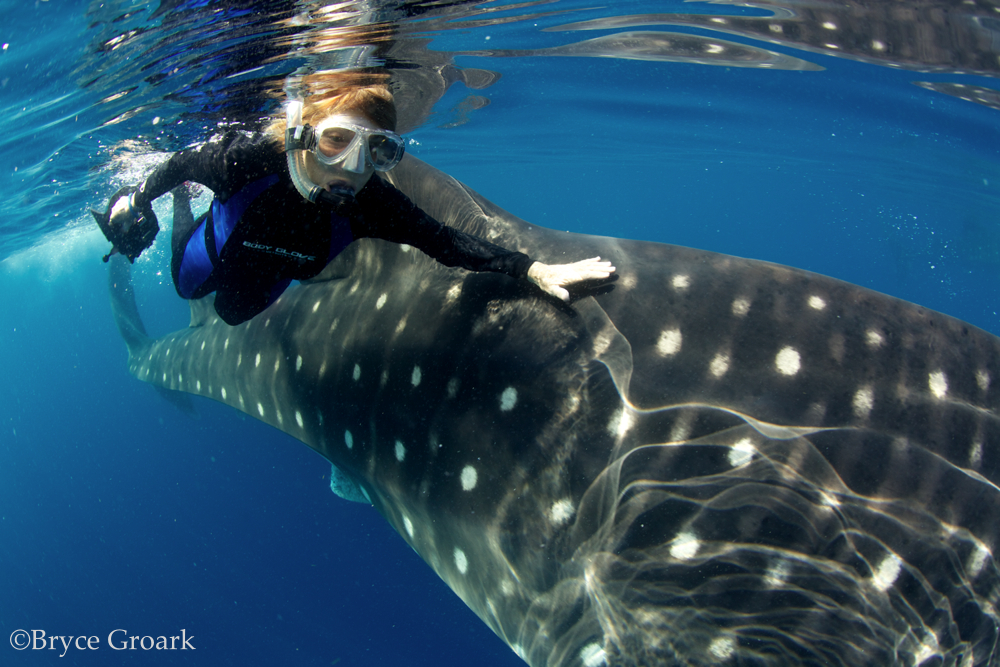
The second reason to fall in love with this film is the main character, Sylvia Earle, a woman that turned 80 in August 2015, who actively keeps studying, exploring, diving, and defending the ocean (learn more
https://en.wikipedia.org/wiki/Sylvia_Earle). Sylvia completed high school at the age of 16, undergrad at 19 and her masters at 20. During her Doctorate, this rhythm slowed down, due to marriage and kids, but soon Sylvia returned to her frantic pace. In 1964, when her kids where only 2 and 4 she traveled for 6 weeks on an expedition in the Indian Ocean. According to Sylvia, she didn't know she'd be the only woman on board, for she was invited as the only botanist, not only woman. A reporter approached her in Mombassa, Kenya, from where the ship would depart, and Sylvia remembered being interested in talking about her work, but the reporter only wanted to know about what being on the ocean with so many men would be like. After all, the article was called “Sylvia sails away with 70 men, but she expects no problems.”
Despite everything appearing well, Sylvia implies in some interviews that her scientific expeditions may have lead to the end of her first marriage. This is a recurring difficulty faced in the scientific world; it is common to have campaigns where the scientists are away for weeks, sometimes months, without any communication with family. In 1966 Sylvia finished her Doctorate, and in 1968 she traveled 30m deep in the waters of the Bahamas in a submersible, 4 months pregnant with her 3rd child and in her second marriage.
In 1969 she signed up to participate in the project Tektite, where scientists lived weeks in a laboratory placed under the sea, at 15m depth. Despite her 1000+ hours of diving experience and her excellent written proposal, she was not allowed to live together with men underwater in Tektike I. The following year however, she was invited to lead the Tektite II project, with a women-only team. The success of this team was an important milestone for women in research, and it set a precedent for future aquatic and space expeditions to include women in their teams.

Picture: Bates Littlehales.
Font: http://images.nationalgeographic.com/wpf/media-live/photos/000/450/cache/sylvia-earle-habitat-window_45011_600x450.jpg

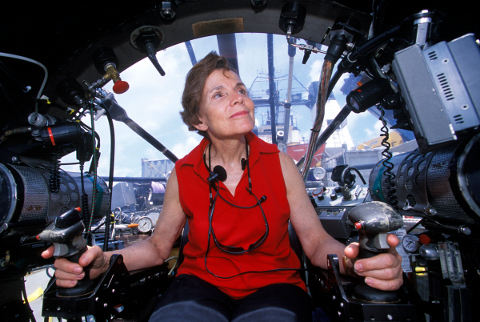
After her experience as a mermaid, Sylvia became a popular face in the media and her career took off (we'd say, all other qualities aside, she also has a lovely face). In 1979 Sylvia walked on the ocean floor at depths never before touched by any other human. This was done using what is called a JIM SUIT, and was used at a depth of almost 400m. This adventure resulted in the book “Exploring the Deep Frontier.”

Image: Dr. Sylvia Earle in Deep Rover Submarine. Font: http://ww2.kqed.org/quest/wp-content/uploads/sites/39/2012/05/Sylvia-Earle-in-a-Deep-Rover_horiz.jpg

In the 80's, together with the engineer Graham Hawkes, she started a company to create submersible vehicles, like Deep Rover. This partnership ultimately led to her third marriage, one where the offspring were the submarines created by them. One of her daughters currently works with her in her company.


When asked if she had problems reconciling family and career, Sylvia says yes, many, and that she tried to rearrange her life, having a laboratory and a library at home. For women that dream about following a scientific career, Sylvia advises “Try, you'll never know how it would be if you don't try.”

Font: http://mission-blue.org/wp-content/uploads/2013/01/IMG_1065.jpg

Wednesday, October 11, 2017

Ugly animals need love too!

Written by: Jana M. del Favero


Illustration by: Joana Ho

   What do a dolphin, a sea turtle, and panda bear have in common? They are considered flag species, meaning they are charismatic species that can draw public attention to a conservationist cause. This concept emerged in the 1980s as a way to ensure conservation of biodiversity. Since it is not possible to finance protection projects for all species of an area, we raise the status of a charismatic species as a means of supporting its overall ecosystem. When I was an intern for the Tamar Project, I was used to receive tourists at the Ubatuba base to talk about sea turtles. While teaching them about sea turtles, I ended up also teaching them about the fish that they consumed and the damages garbage and automobile use in spawning areas caused, etc. The main message always went through several other messages. Whenever we talk about the importance of preserving the flag species, we also talk about the importance of preserving the entire ecosystem.

   Although it is an efficient concept (who does not think about the Panda Bear when thinking about WWF?), its application requires caution. By prioritizing flag species, you run the risk of not preserving those who really need to be preserved. It is important to remember that several species are threatened with extinction. Some scientists even argue that we are going through the sixth major extinction of the Earth (episodes in which large numbers of species go extinct in a short period of time).

    According to scientists all prior mass extinctions were caused by natural catastrophes, such as the fall of a meteorite. However, WE (human beings) are causing the sixth extinction! Paradoxically, although WE are causing the sixth extinction, WE are also the ones that can prevent it from being more tragic.

   So, it was in thinking about the protection of a group of endangered and "disadvantaged" animals that the biologist Simon Watt created the “Ugly Animal Preservation Society.” No, that is not a type, this idea was quite contrary to the use of traditional flag species. According to the creator, it is not fair that the panda gets all of the attention.

   The innovative idea of Simon Watt did not stop with the creation of the society. To raise funds and save aesthetically unprivileged species, he and a group of artists ventured into the United Kingdom, performing shows and stand up comedy, in which each artist featured an ugly animal. At the end of each evening, people could vote on what should be the mascot of society.

 Among some strong competition of the weirdest frogs, salamanders, snails and insects, the winning mascot was a fish, the Blobfish. Besides being ugly, this fish, scientifically called Psychrolutes marcidus, inhabits the deep waters (between 600 and 1200 meters deep) of South Australia, including Tasmania. They have no swim bladder, only the minimum number of bones needed for survival, and their body has a gelatinous consistency. But these characteristics all contribute to being able to live in their high-pressure environment, with the water around them as their main structural support.

   But I confess that I found the vote somewhat unfair. Knowing that every 10 meters that we dive to find the Blobfish, the pressure increases by 1 atm. We would meet the ugly creature in an environment with more than 60 atm of pressure pushing down on us, and our organs would crush and we would probably look like paste (actually we would have died long before!). Meanwhile the Blobfish would look like an "ordinary" fish and not the gelatinous creature we thought so ugly while we analyzed it on the Earth’s surface, at only 1 atm.

Cover of the book written by Simon Watt with an image of the mascot of the "Society of Preservation of Ugly Animals," the Blobfish.

   Another marine fish that competed as the ugliest animal was the European eel (scientific name: Anguilla anguilla). Although it is critically endangered and it looks more like a snake than a fish, I believe that this species should not even be in this competition because they are wonderful! The European eel is a euryhaline fish, which withstands great variation of salinity, and is catdromic, meaning it grows in rivers and spawns at sea. In addition, it has leptocephalus larvae, which look beautiful, last about 3 years, and reach up to 8 cm in length!

European eel: adult (left) and larva (right)


   So, have I been able to convince you that the European eel and the Blobfish are not ugly, but that they do need our attention and protection?

   In your opinion, which endangered animal is ugly and should be preserved?

About the “Ugly Animal Preservation Society” (Come in and laugh a lot watching the videos): http://uglyanimalsoc.com

Friday, June 10, 2016

When to add children to the academic timeline?


When starting a research project, it is necessary to establish a project timeline in which all of the activities to be carried out are mapped out to keep on schedule. My question, one I know other women ask as well, is where and how to fit a pregnancy in the academic timeline?


During undergrad, we're too young and have the whole world ahead of us; during a masters', time is short, we have approximately two years in which it is impossible to think of things other than classes and the thesis. Then comes the doctorate. We're more mature, some are already married, but we still only think of research and publications – we know that after the four years of the doctorate we'll face the competition for jobs or need to be able to engage in a postdoctoral position. Therefore, the best option would be to wait for all of that to end, and decide to get pregnant after getting hired, with some professional, financial, and personal stability guaranteed. That stability generally occurs when a woman is around 37 years old, though, long after her fertility peak (Figure 1).


Figure 1. The age at which a scientist builds her career occurs at the same time of peak fertility
(measured by the number of ovarian follicles). Source: Willians & Ceci (2012).


Although it is not difficult to name successful female researchers/professors with kids, the “graduate students that gave up their academic career after getting pregnant” scenario is far more common. As Figure 2 shows, the dropout percentage amongst post-doctorate researchers with no kids or plans to have kids is practically the same for both men and women. However, having a child after starting a post-doc doubles the dropout rate among women, but has no effect for men.


Figure 2. Influence of children and plans to have children in the postdoctoral
careers of men and women. Source: Williams & Ceci (2012).

Of course a child can alter a woman's life path, and also her academic productivity. Leslie (2007) shows that the more children a woman has, the less time she spends on professional activities (Figure 3). Shockingly (although the research dialog doesn't discuss reasons), the same study shows that the effect is reversed in men: more kids equals more working hours! I won't dare to go further in discussing causes for this difference, but I see two possibilities: a man sees it as more responsibility and, seeing himself as the family provider, works more (this is not necessarily his fault, the systemic tradition imposes and teaches women to take care of their home and men to provide for it); or they run from the domestic responsibilities for whatever reasons. A friend told me that when his child was a baby and required all mom's all attention and care, he would prefer to work late to avoid getting home before the baby was asleep, justifying himself by saying he was jealous of all the care his spouse had for the baby and felt he didn’t fit in his own home.

Figure 3. The number of hours worked weekly for men and women compared to the number of dependent children. Source: Leslie (2007).

One way to enhance female representation in universities and to reduce the academic dropouts is to focus on the problems mothers face to take care of a family while studying and researching. Williams and Ceci (2012) made a list of strategies that could be adopted to minimize problems and help families. As an example: universities could offer quality childcare, offer maternity leave for the primary care giver, regardless of sex; they could also instruct selection committees how to ignore curriculum gaps that happened while one was using more time to take care of the family (as an example, the committee would understand why someone didn't publish for some time if that time was used to take care of a newborn), and so on. What is not on the study's list, and what I consider extremely important, is a structural change in people's minds. I heard once that, to be accepted in a certain lab in Spain, the professor in charge would ask women to sign a form, agreeing not to get pregnant during the doctoral program. It's painfully hard to believe many minds still work like that!

And back to Brazil, where are we? USP, one of the largest universities in Brazil, has a childcare center that is praised by the parents, but just got at least 117 spots suspended for lack of funds invested in them (read more here). Not all funding agencies provide paid maternity leave for those with grants. Some progress can be seen, but many setbacks are still noticed. Even though some universities have adopted measures to help families' lives, a lot still need to be done.

I'll not be able to give an answer to the question I posed in the text's title here, mostly because I believe it's a personal decision and not just a cake recipe. Personally, I've been married for 3 years and will finish my PhD in the middle of 2016, with no intentions of expanding the family by then.

Nonetheless, I will not end the post with this matter. The blog will have testimonials of “women who are warriors,” that managed to study and have children; “altruistic women,” that gave up their academic career to dedicate themselves fully to their family and feel good about it; “scrappy women,” that stepped out of the university for a while to take care of kids and suffered many obstacles to get back in. My testimonial of an “indecisive woman” you already have.

What about you, have something to share? We welcome you to comment or contact us.


References


Goulden, M.; Frasch, K.; Mason, M. 2009. Staying competitive: Patching America’s leaky pipeline in the sciences. Center for American Progress,


Leslie, D.W. 2007. The reshaping of America’s academic workforce. Research Dialogue 87. https://www.tiaa-crefinstitute.org/public/pdf/institute/research/dialogue/87.pdf


Willians, W.M.; Ceci, S.J. 2012. When Scientists Choose Motherhood. American Scientist, Volume 100. http://www.americanscientist.org/issues/pub/when-scientists-choose-motherhood

Tuesday, August 11, 2015

Three minutes, one slide, and lots of fish eggs


Would you be able to explain your research to an audience of academics from all different disciplines, in just 3 minutes, with only one slide? That is the premise of a competition called the Three Minute Thesis (3MT). 3MT was created at the University of Queensland, Australia in 2008, and it has been performed at the University of Massachusetts Dartmouth, USA since 2011. (Details about the competition can be found here: http://www.threeminutethesis.org).


While thinking about the goals of this blog, I decided to participate in the competition this year, as it does exactly what we try to do here: talk about science to a diverse audience while keeping it interesting and educational. I signed up thinking only about the training; I would have to prepare and memorize my text and then deliver the presentation (in English!). Of course, I also had the ultimate goal of winning (who turns down a chance to earn $1,000?).


Unfortunately, I did not get rich on April 29th, 2015, but as expected, it was great practice and lots of fun. It was interesting to watch presentations about the research from various fields: engineering, arts, administration, etc. There were nervous people and people who seemed to have come straight from a theater stage. You can watch some videos of previous years by visiting the following website: http://www.umassd.edu/graduate/spotlights/three-minutethesiscompetition/.


You can read the transcript of my talk and learn more about my research below:


Many people do not know, but fisheries management is not just based on adult population data. It is also important to study early life stages for better stock management. For example, as fish eggs are usually spawned in the water column, knowing when and where they are helps to define spawning sites and periods.


But, before doing any kind of fish studies, it is necessary to know who they are. Fish egg identification is time consuming and difficult. After sampling on board, you need to sort all of the fish eggs from the plankton sample, using a microscope. Sorting the eggs from the family I am studying is easy because their eggs have an ellipsoid shape.


The problem is reaching the species identification. As each group presents different size and shape, the identification has previously been done by manually measuring each egg and then counting.

Figure 1. The single slide presented during the competition. The eggs illustrations are from Nakatani (1982).


In my doctoral thesis, I want to verify long-term fluctuations in the abundance and distribution of eggs from a fish named Argentine anchovy on the Brazilian coast. This small fish is one of the most common fisheries resources in Argentina and Uruguay. At the Brazilian coast they haven’t been commercially fished yet, but some studies have suggested that Argentine anchovy can be sustainably fished in Brazilian waters.


Coming back to my thesis, when I mentioned that I am studying long-term fluctuations, I didn’t mention that by long-term I meant 40 years of data, totaling almost 2000 samples. That is a huge amount of samples and it would take my whole PhD period just to identify all the eggs. The solution was to create a faster and more accurate methodology, so I did it.


I used a digital camera attached to a microscope to image the eggs, and using the photos, I got the measurements. After that, I created a model that automatically gave me the counts of eggs within each species. This new model has over 90% accuracy and can be used by any researcher to optimize their time and effort.
In the end, besides taking four years to identify the eggs for my thesis, I identified more than 100,000 anchovy eggs in just one year, allowing enough time to continue my research project.  


If you are interested in this methodology, the paper is already in publication, and it can be accessed in the following link or requested by email.


See you soon.

Devastatingly beautiful: the growing problem of Lionfish invasion

By Corey Eddy and Jana M. del Favero

Two lionfish have been sighted in Brazil, both in the southeastern area of Arraial do Cabo (Rio de Janeiro). The first one was in 2014 and another more recently in March 2015. But with only two individuals spotted, why should we care?

The lionfish!

Brazilian experts are still debating how these lionfish ended up in the Brazilian waters and if there may be more individuals in deeper waters, not observable by divers (details at: http://ciencia.estadao.com.br/blogs/herton-escobar/mais-um-peixe-leao-e-encontrado-na-costa-brasileira/).

While there is no consensus, I asked a colleague, Corey Eddy, to write about the invasive population of lionfish in Bermuda; I wanted to know what is being done there and what measures could be adopted in Brazil. Below it is the text he wrote:

Since the discovery of lionfish in Florida in 1985, their population expanded rapidly to stretch from Venezuela to Rhode Island (US). It was thought their range of invasion could eventually stretch as far south as Uruguay. As lionfish are recognized and avoided by prey in their native territory, they have evolved into opportunistic predators with broad diets. However, due to prey naivety in their invasive range, lionfish are able to consume large quantities of invertebrates, juvenile fish, and small-bodied adult fish, many of which play important ecological or economic roles. Consequently, research shows that lionfish can reduce juvenile reef fish populations by nearly 80% in as little as five weeks. Bolstered by the lack of any natural predator, lionfish populations in the Atlantic have reached densities far greater than in their native range, with the potential to affect community structure, biodiversity, and the health of coral reef ecosystems. Fortunately, they are delicious and it only takes one minute to remove their dangerous spines, making them perfectly safe to handle. If we can create a fishery for them, we can save the ocean. We have to eat them to beat them.

Representation of the worldwide lionfish distribution. Diagram by Naira Silva


My doctoral work is part of a larger project, funded through the UK’s Department of Environment, Food and Rural Affairs, that is investigating the biological and ecological characteristics of the lionfish population around Bermuda and the potential impact lionfish may have upon the structure and function of Bermuda’s coral reef ecosystem. For my first chapter, I will be using the data we collect on lionfish abundance and distribution to estimate the population size. Our team is assessing lionfish abundance via underwater visual surveys at 15 sites in each of five depth zones across the Bermuda platform (10, 20, 30, 45, and 60m) using SCUBA or appropriate technical diving equipment (i.e. trimix diving with multiple tanks). Using a roving search protocol that encompasses cryptic habitats, divers record all lionfish seen and attempt to capture each individual using a pole-spear. Following capture, all lionfish are measured, weighed, dissected, and processed for further analyses. Belt-transect surveys of reef fish, focusing upon small and cryptic species, are conducted concurrently to determine the abundance and distribution of potential prey. A number of these sites are being resurveyed after one year to assess re-colonization rates. This data will also facilitate the development of a distribution map that aids removal activities targeting lionfish at key locations and times that account for seasonal population fluctuations and movement patterns.

Photo by Jorge Sanchez

My next two chapters will document the life history characteristics of this species to estimate population growth as it pertains to their potential ecological impact. In chapter two, I will examine the demographics of the lionfish population as well as growth rates and longevity of lionfish in Bermuda. This work utilizes standard otolith (“fish ear bone”) aging techniques applied to specimens captured during our underwater surveys and opportunistically from other divers, commercial fishermen, and permitted lionfish hunters. Following this, my third chapter will examine the reproductive condition and quantify the fecundity of lionfish. Gonads will be weighed, sectioned, and analyzed by traditional histological methods to determine overall fecundity, reproductive seasonality, and the developmental stage of fish, thus providing an estimate of the reproductive potential driving the overall population growth.

In my final chapter, we are investigating the feeding ecology of lionfish to explore the impact they may have on the native fish and invertebrate communities, as well as the entire local ecosystem, and to identify factors driving the population’s distribution. This research involves conventional stomach content analysis (SCA) complemented with more advanced stable isotope analysis (SIA) that reveals details not detectable through traditional methods. Because the stable isotope ratios of carbon (13C/12C) and nitrogen (15N/14N) in the tissues of predators are directly related to the ratios found in their prey, the change in these ratios relative to a standard, δ13C and δ15N, are used to indicate the primary carbon sources for a consumer and an estimate of trophic position, respectively. To further indicate the potential impact of lionfish on Bermuda’s reef ecosystem, we will also perform this analysis on prey species (i.e. those identified by the SCA) and others we know are competing with lionfish for these same resources. By plotting δ13C and δ15N of lionfish and these various species, we can see the extent to which lionfish are utilizing resources needed by native species.

When completed, this project will estimate the extent to which invasive lionfish could impact Bermuda’s coral reef ecosystem and help mitigate that impact by providing data on lionfish abundance and distribution to assist the Bermuda Lionfish Task Force and the Department of Environmental Protection (http://www.lionfish.bm) in developing a comprehensive plan that facilitates large-scale, long-term removal of this species from local waters. Controlling and reducing the continued growth of the lionfish population is a crucial part of any effort to minimize negative impacts on native fish species and coral reef ecosystems, and avoid secondary impacts on fisheries and tourism.

In addition to my doctoral research, I am heavily involved in public education and one of the projects I work on may be very useful to implement in Brazil. As a volunteer for the Ocean Support Foundation (http://www.oceansupport.org), I run the Bermuda Lionfish Culling Program on behalf of the Department of Environmental Protection. This program allows any Bermudian resident, over 16 years of age, to receive the proper training and a special permit to hunt lionfish. This is different from a traditional spearfishing license because permitted lionfish hunters are allowed to hunt lionfish while using SCUBA, within one mile of shore, and on shipwrecks and other protected sites, situations normally forbidden by Bermuda law. To date, we have certified over 500 hunters, all of whom are a major help in removing lionfish and keeping Bermuda’s reefs clean and healthy. As Brazil has only recently been invaded, these early days are the perfect opportunity to mobilize SCUBA and free divers, fishermen, and environmentalists to get into the water and start hunting. Every lionfish that is removed greatly helps to preserve and protect Brazil’s marine environment, especially at this early point, when there may be very few lionfish around.  

Corey Eddy biography:
Photo by Groundswell Bermuda.
Corey Eddy is a PhD candidate at the University of Massachusetts Dartmouth. He received his bachelor’s degree from the University of Rhode Island, whose study abroad program first brought him to Bermuda for a semester at the Bermuda Institute of Ocean Sciences. He is also a Fellow through the National Science Foundation’s Graduate Research Program and a member of the Bermuda Lionfish Task Force. As a volunteer for the Ocean Support Foundation, he developed and currently manages the Bermuda Lionfish Culling Program on behalf of the Department of Environmental Protection. His research interests focus on studying the life history characteristics, habitat use, and feeding ecology of ecologically important predators.
Contact: corey.eddy@umassd.edu