Marcadores

Showing posts with label Women in Science. Show all posts

Thursday, September 27, 2018

Challenges faced by women in science

English edit by Katy Shoemaker


A debate at the Institute for Advanced Studies (IEA-USP) recently got my attention, entitled “Women in the University and Sciences: Challenges and Opportunities. If you can understand a bit of Portuguese, it is worth watching the entire video (it is only available in portuguese). The debate lasts around an hour and consists of three female scientists telling incredible statistics and surprising facts about women’s participation in the academic world, and some of these facts are really hard to believe.


So this week, I want to discuss some of the facts included in this debate. To do that, I searched for more data so we can go deeper into the subject. First of all, I was happy to find out that women represent about 50% of the undergraduate students in Brazil. We are even the majority in some areas. However, when we look only at the sciences and engineering, women make up less than 40%. At the University of São Paulo, USP, a paltry 15% of the students enrolled in engineering courses are female.


Extending beyond undergraduate education, there are also as many women as men in graduate and postdoc positions in Brazil. In fact, in 2010, more women earned Masters and Ph.D. titles than men. But again, that is not the reality in science and engineering. There is still something hampering our inclusion in these areas, including oceanography.
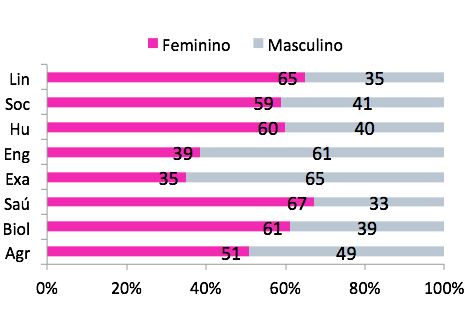

Number of scholarships per area in 2014. Source CNPq. Women: Feminino; Men: Masculino.


The most shocking numbers are those related to the distribution of specific research grants called PQ grants. These grants are awarded to researchers for research excellence, and they determine the distribution of funding to research projects in the country. Therefore, PQ grants directly affect our performance as researchers. PQ fellowships are tiered, and women's participation decreases as we go up each level. Note that women receive no more than 38% of these grants, even at the lowest level.
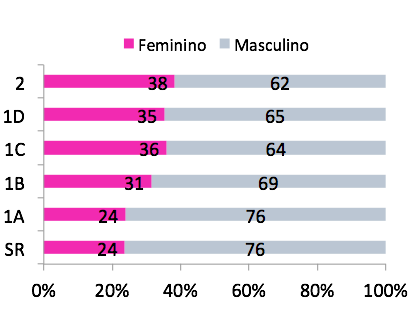

PQ research grants per level in 2014. Level 2 is the lowest category that a researcher can apply for, whereas SR is the highest level. Source: CNPq. Women: Feminino; Men: Masculino.

It is clear from these two plots that there is both horizontal and vertical segregation of men from women. Women appear to be concentrated in certain careers (horizontal), but within a career, there is a vertical separation of power, with women having low representation in the highest positions.


We find more examples of vertical segregation when we analyze leadership positions in large research groups. In Brazil there are currently 126 National Institutes of Science and Technology (INCTs). Well, 109 of those INCTs are run by men and only 17 by women. There are 6 INCTs focused on oceanography/marine science, and only one of those is lead by a woman (Antarctic Environmental Research - INCT-APA).


An all too common scenario can be seen in the Brazilian Academy of Sciences (ABC). The following data was presented by the physicist Carolina Brito (Federal University of Rio Grande do Sul) in the debate I mentioned at the beginning of this post. For a researcher to join ABC, he/she is nominated by an ABC member and a committee decides whether or not that researcher will enter. This committee is massively comprised by men, and as you can imagine, the result is not at all encouraging for female scientists. There is a list of the current ABC members on their website. There are 795 men and 122 women in ABC. From these, 15% of the men are below the 1A level in the CNPq, and only 1% of the women are below level 1A researchers. A fast interpretation we can make is this: if you want to be a member of ABC, and if you are a woman, it is almost mandatory to be a level 1A researcher or higher. For men, this standing does not have the same impact.


Unfortunately, this reality does not seem to be getting any better. In 2008, 20% of the deans in universities were women, and 8 years later, this number dropped to 10%. Although 48% of the Ph.D. holders are women, only 23% of them occupy teaching positions in our public universities. In a previous post we have addressed some of the reasons for why women quit the academic career at a higher rate than men (When to add children to the academic timeline).


So, what can we do to change that picture?
1 - The data presented here is limited. We need numbers, we need more indicators.
2 - We need training on gender issues. In France, curriculum was recently modified to discuss gender in all undergraduate courses. That sounds like a good start.
3 - We need to fund women's projects, provide scholarships, and reward them. We have very few initiatives, but these have incredible effects. Check out the post Finding self-confidence as a woman in science to see Deborah's testimony on the importance of being recognized in her area.
4 - We need role models. Young female scientists do not see people like themselves in power positions regularly enough. Socially, girls are still discouraged to pursue scientific careers that are considered "hard." From a very young age, we are overwhelmed with ancient cliches telling us how to take care of the house, how to be good wives, mothers, true ladies of our homes. We have to give girls the opportunity to fall in love with science and make them confident that this relationship can work. The L'Oreal Foundation recently conducted an opinion poll that demonstrated how Europeans feel about the role of women in science. Five thousand people were heard (men and women), and 67% said that women are not qualified to hold positions of high responsibility. The main reason being that "women would suffer from lack of perseverance, lack of practical spirit, scientific rigor, rational, and analytical spirit."


All I have to say about this is: It’s time to get to work! At the VII Brazilian Congress of Oceanography there was a round table discussion on the subject, with a crowded room of people eager to speak. Although it was an excellent experience, there is still so much to discuss. So I want to invite you all to continue this discussion. Let's talk about gender in the spaces we occupy, spread this idea! Organize an event and call everyone you know. Share your experiences with us!


References on statistics:


Thursday, May 4, 2017

Attention before boarding!

by Catarina Marcolin


Image by Caia Colla

Hello to all again. It has been some time since I last wrote for this blog, even longer since I've boarded a ship, but many memories came to me after the World Ocean Day. Most memories are good, but some, not so much.

In posts published on this blog, you might have read about the adventures of working at sea, diving to the bottom of the ocean, or traveling the world in foreign ships. But working on an oceanographic vessel is not always a fantastic experience, especially if you are a woman.

It is important to be mindful that, when on a ship, one is also confined, surrounded by the ocean. Often, there is no access to a telephone, no internet, no way of visiting friends or family, and no way of going home whenever you want. In at least the last five oceanographic cruises I have participated in, I met only one female crewmember - she was a nurse on a supply ship which assisted oil platforms. On oceanographic ships, don't expect to see crew-women. In the scientific crew, yes, it is easier to find women, even when there's clear preference for men, because many tasks involve body strength. There's a need to carry boxes, nets, flasks, and other heavy equipment. But that’s not all! To be successful, the science crewmembers need strong skills in leadership, taking initiative, communication, management, and dealing with equipment. The work is very challenging, but against the common sense, I met women that are far better than a lot of guys in crew.

I was once stopped from boarding a boat that was poised for my doctoral research, under the “argument” that there were no suitable facilities on the boat for a woman.

If you think that this isn’t a big deal, and that this male to female imbalance in passengers on ships is normal, maybe you can imagine some level of vulnerability that women may be subjected to in such an environment. I have always been aboard research cruises with large groups of researchers and wonderful ship crews. I have always been treated with respect. Unfortunately, this level of respect is not always found in day-to-day research cruises.

To illustrate this vulnerability, I interviewed two biologists that told me about very inadequate situations they've been through while aboard a boat off of the Brazilian coast. In this post I'll tell the story of one of them; she decided to stay anonymous, so I'll refer to her as M.
CWN: Have you ever been excluded from an expedition so a man could go in your place?

M: That has never happened to me, although there is a preference in our laboratory for men to go, under the argument that there is a need to carry heavy objects on board.

CWN: How many times have you worked on a boat, and in how many of those trips did you feel uncomfortable or find yourself in inconvenient situations that made you feel insecure?

M: I have been on four cruises. Two of them put me in very uncomfortable situations, and I felt insecure in one of them.

CWN: Could you share a story about an uncomfortable situation you've been through?

M: I was on a ship twice, consulting in an environmental monitoring study. One of the crewmembers that worked on the deck made constant jokes about my accent. But he had issues with other members of the staff too.

The second situation, the one that made me feel insecure, happened on a ship that I rather not say the name of or the institution it's related to. I never thought I would go through that experience on a vessel connected with such a respectable institution. I had heard rumors about expeditions from the past, and I confess, I was a little worried about this experience, but I never thought that what happened, could have.
Some of the crewman had very inappropriate behavior. Everyday we would share the dining room with them. Before we had the chance to finish our meals, some of them (that had a high position in the boat's hierarchy) would play music videos of half-naked women (funk, axé, pagode) that always had images of men and women in insinuating situations, alluding to sexual acts, and very loud. Aside from that, every day there was drinking, and the crew would exhaustively offer us alcoholic beverages, especially to women, with the clear intention of trying to get us intoxicated. They would try to exalt their merits all the time, as an attempt of conquest. I would leave the room when those activities started, and some men would come after me asking why I wouldn't join them, insisting, and harassing me.
This didn't bother only the women, several of our male colleagues were also bothered, but they never spoke up. This situation kept growing, leading up to my next story. It is important to say that this was not everyone's behavior. While we were harassed by some, other crewmen treated us respectfully.
On one particular day, there was a get-together with a barbecue, and drinking started early in the morning. One of the crewmen drank so much he threatened to jump off of the boat, which caused a lot of confusion and trouble. During dinner, one of our male colleagues was eating while one of the falling-over drunk crewmen, spilled beer on the table. After a useless effort to clean it, he threw a dirty napkin on our colleague's plate, which really upset our colleague, as the action was interpreted as a racist move.
Facing all of that mess, I could not even have dinner that day because of all the embarrassment. I went to the pantry to get a piece of fruit and stopped for a while to talk to one of the crewmen about the situation. Then, another drunk crewman came over and started asking questions about one of my female colleagues. I tried to leave, but he kept stopping me and asking me to bring my friend. The other crewman that I was talking to defended me, so I could get out. I realized there were a lot of crewmembers feeling a sense of indignation, because their professional class could not tolerate this kind of behavior. What left me feeling more insecure was the fact that we could never talk to the captain of the ship; we could never see him and he never answered our calls or our contact attempts.
Luckily for us, one of the crewmen took our case to the captain, who took some action, we don't know what, but we didn't see the crewman that caused most of the trouble again. We were called to a meeting with the chief mate that finally listened to our claims and had a meeting with the “troublemakers,” forbidding the use of alcohol, the insulting videos, and the behaviors that caused us discomfort. The captain asked the harasser to publicly apologize to me and my colleague (about the dinner event), but nothing else happened to the other harassers.

During that expedition, something broke on the ship, so it was not possible to collect all of our research samples. The ship lost its speed and couldn't sail properly. The ship didn't land where it should have, taking us straight to the final destination, and the reason for that was not disclosed to us researchers. It took seven days to get to the final spot, all while we didn't know what was happening.

This same ship and crew were available to us again to finish the work that was not concluded. I was again in that expedition, and thankfully, we didn't have any other embarrassing situations arise.

However, there was a stressful and worrying situation. We were dragging a bongo net, which was supposed to go down to 200 m. We realized that was taking too little time. We found out that the person responsible for operating the hoist received orders from a superior crewmen to release less rope than needed so the work would be finished faster, which compromised our sampling and data quality.

CWN: Why do you think the crewmember responsible for the operations tried to sabotage your work? Do you think it was ignorance or a deliberate attempt to “get revenge”?

M: I have no idea. We didn't get an explanation. We don't know if it was revenge, if it was disrespect for us being women (the chief of the expedition was a woman), if it was laziness, impatience to get back home, disrespect for the work environment… Anyway, whatever the motive was, it is very lamentable for all it represents, and it is a waste of public money!

It is also very important to consider the loss of valuable scientific information, caused by irresponsible and unreliable work from the ship crew. This is especially true for the current state of our country, where obtaining resources for field collections in ocean research has been increasingly difficult.

In the end, all stories I hear and share show clearly that while on a ship, being it for scientific research or parallel consulting, there is prejudice coming from the male crew towards women. Women are still thought of as the “fragile sex.” This inappropriateness makes life on board even more challenging when the day-to-day work already demands physical strength and adaptations to the labor done in an environment ruled by the movement of the marine currents. 

Thursday, November 10, 2016

Finding self-confidence as a woman in science

By Deborah Apgaua

In 2016 this year I received an international award that changed my life and perspectives about many aspects on science. This award was granted by the Schlumberger Foundation under their Faculty of the Future program, and is intended for women from developing countries to conduct research in the fields of science, technology, engineering and math (STEM). The program aims to form a transformative network where men and women have similar opportunities in the job market.
Illustrated by Caia Colla
To be a woman in science is still a challenge, especially in a developing country like Brazil, where the biggest portion of professors in STEM are men, and where gender imbalance is evident in leading positions. According to a post already published in this blog (o sexo realmente importa?), it may help to reverse this scenario by accepting that this gender imbalance exists, but this has still not happened. Even more importantly, an increase in self-confidence in women could help to break this barrier towards a greater female participation in STEM.

The possibility of pursuing post-doctoral research overseas is of course an important component of the satisfaction that I feel after winning the award. To be part of the Faculty for the Future community that searches for new directions for science enhanced my self-confidence to develop research and to become a role model to inspire other women to follow a similar path. Therefore, way before I started my research, I already felt a big change in the way I expressed my ideas and guide students in their work.

When I decided to try this program, I had to remember and mentally organize my entire academic carrier from my undergrad to my doctorate. I had to search for value in each experience and think about how these experiences can help me inspire other women. Thus, I discovered a new force that was inside me, something that I did not know. Before submitting the proposal for my research, I reread it and felt fulfilled, regardless of the application results. I asked myself how many women could feel this contentment if they remembered each step of their journey and add value to their work.

For example, I realized that I have more teaching experience than I was aware. During my undergrad, I developed research in traditional communities where I participated in giving short courses and presenting user-end research outcomes.  Besides this, during my postgrad I had acquired experience through teaching placements, and this counts as teaching experience even if it was with the assistance of my supervisor. While doing part of my doctorate studies overseas, I kept in touch with my work mates back in Brazil, and helped in reviewing academic texts. Therefore, I could see the relevance of all those moments when I had to convince the Schlumberger Foundation that I am a candidate that deserves the award.

To believe in this reality without diminishing myself, but on the contrary, finding merit in my academic choices, I did not worry about what I could have done but I didn’t. When I was interviewed in English with the intention to confirm what I wrote, I did not present myself as a “serious and baddie” person trying to show a masculine stereotype to express power. On the contrary, I was friendly and feminine finding confidence being myself.
When I received the positive results on my proposal, the “insecure girl that could not express her scientific ideas because she did not believe it was relevant” disappeared. As I resonate with the philosophy of the Faculty for the Future program, I decided to accept the mission to engage and encourage more women in science. I have chosen to embrace the strong woman that was sleeping inside me and see myself as a scientist that searches for even more experiences knowing that I still have a lot to learn.

Since that moment, with my self-confidence renewed, I have talked to women in my university and from other institutions and I see their countenance changing as I point to the possibility of a simple path to achieve their goals. The change is inside us, because many times we boycott ourselves, with insecurity and low self-esteem. Focus and self-confidence are the key ingredients for our transformation.

Talking with female post-grad students in my department, I noticed that some of them are afraid to become a “shadow” of their male counterparts.  Perhaps this is a result of a predominantly male work environment where only three out of 31 professors are women. However, this is a fear that freezes, and it is only by acting on our academic goals that we can be free from this self-perceived subordination. So when we overcome the insecurity and fear of being overshadowed by men in science, we are on our paths of knowledge that will bring us to academic success.

Overcoming our insecurities and fears is also facilitated when we understand that we do not do science alone and that working together with others is essential. This way, we can transform competition to collaboration, and not have to feel that we are alone in our academic endeavors at every step of our work. Scientific knowledge is an ever-expanding thing.  Men or women alike, trusting that science moves forward by our combined efforts reduces our ego and dispels the perceived ideal that we have to know everything to be able to do good science.


Relevant Links:


About Deborah:


I am a doctor in forest ecology, and I have a deep love for the world’s tropical forests. I have graduated in biology during which I studied ethnobiology. During my masters and PhD I worked with forest ecology to be in contact with Brazilian forests. During my Ph.D however, I ended up going to Australia where I developed a project with plant functional traits in rainforest plants. More recently, I am preparing to go back to Australia again to pursue a post-doc, supported by an award that I received for women in science. I aim to understand how plants cope with drought through their traits and bring this knowledge to Brazil. I hope to inspire other women to pursue the academic career.


Friday, June 10, 2016

When to add children to the academic timeline?


When starting a research project, it is necessary to establish a project timeline in which all of the activities to be carried out are mapped out to keep on schedule. My question, one I know other women ask as well, is where and how to fit a pregnancy in the academic timeline?


During undergrad, we're too young and have the whole world ahead of us; during a masters', time is short, we have approximately two years in which it is impossible to think of things other than classes and the thesis. Then comes the doctorate. We're more mature, some are already married, but we still only think of research and publications – we know that after the four years of the doctorate we'll face the competition for jobs or need to be able to engage in a postdoctoral position. Therefore, the best option would be to wait for all of that to end, and decide to get pregnant after getting hired, with some professional, financial, and personal stability guaranteed. That stability generally occurs when a woman is around 37 years old, though, long after her fertility peak (Figure 1).


Figure 1. The age at which a scientist builds her career occurs at the same time of peak fertility
(measured by the number of ovarian follicles). Source: Willians & Ceci (2012).


Although it is not difficult to name successful female researchers/professors with kids, the “graduate students that gave up their academic career after getting pregnant” scenario is far more common. As Figure 2 shows, the dropout percentage amongst post-doctorate researchers with no kids or plans to have kids is practically the same for both men and women. However, having a child after starting a post-doc doubles the dropout rate among women, but has no effect for men.


Figure 2. Influence of children and plans to have children in the postdoctoral
careers of men and women. Source: Williams & Ceci (2012).

Of course a child can alter a woman's life path, and also her academic productivity. Leslie (2007) shows that the more children a woman has, the less time she spends on professional activities (Figure 3). Shockingly (although the research dialog doesn't discuss reasons), the same study shows that the effect is reversed in men: more kids equals more working hours! I won't dare to go further in discussing causes for this difference, but I see two possibilities: a man sees it as more responsibility and, seeing himself as the family provider, works more (this is not necessarily his fault, the systemic tradition imposes and teaches women to take care of their home and men to provide for it); or they run from the domestic responsibilities for whatever reasons. A friend told me that when his child was a baby and required all mom's all attention and care, he would prefer to work late to avoid getting home before the baby was asleep, justifying himself by saying he was jealous of all the care his spouse had for the baby and felt he didn’t fit in his own home.

Figure 3. The number of hours worked weekly for men and women compared to the number of dependent children. Source: Leslie (2007).

One way to enhance female representation in universities and to reduce the academic dropouts is to focus on the problems mothers face to take care of a family while studying and researching. Williams and Ceci (2012) made a list of strategies that could be adopted to minimize problems and help families. As an example: universities could offer quality childcare, offer maternity leave for the primary care giver, regardless of sex; they could also instruct selection committees how to ignore curriculum gaps that happened while one was using more time to take care of the family (as an example, the committee would understand why someone didn't publish for some time if that time was used to take care of a newborn), and so on. What is not on the study's list, and what I consider extremely important, is a structural change in people's minds. I heard once that, to be accepted in a certain lab in Spain, the professor in charge would ask women to sign a form, agreeing not to get pregnant during the doctoral program. It's painfully hard to believe many minds still work like that!

And back to Brazil, where are we? USP, one of the largest universities in Brazil, has a childcare center that is praised by the parents, but just got at least 117 spots suspended for lack of funds invested in them (read more here). Not all funding agencies provide paid maternity leave for those with grants. Some progress can be seen, but many setbacks are still noticed. Even though some universities have adopted measures to help families' lives, a lot still need to be done.

I'll not be able to give an answer to the question I posed in the text's title here, mostly because I believe it's a personal decision and not just a cake recipe. Personally, I've been married for 3 years and will finish my PhD in the middle of 2016, with no intentions of expanding the family by then.

Nonetheless, I will not end the post with this matter. The blog will have testimonials of “women who are warriors,” that managed to study and have children; “altruistic women,” that gave up their academic career to dedicate themselves fully to their family and feel good about it; “scrappy women,” that stepped out of the university for a while to take care of kids and suffered many obstacles to get back in. My testimonial of an “indecisive woman” you already have.

What about you, have something to share? We welcome you to comment or contact us.


References


Goulden, M.; Frasch, K.; Mason, M. 2009. Staying competitive: Patching America’s leaky pipeline in the sciences. Center for American Progress,


Leslie, D.W. 2007. The reshaping of America’s academic workforce. Research Dialogue 87. https://www.tiaa-crefinstitute.org/public/pdf/institute/research/dialogue/87.pdf


Willians, W.M.; Ceci, S.J. 2012. When Scientists Choose Motherhood. American Scientist, Volume 100. http://www.americanscientist.org/issues/pub/when-scientists-choose-motherhood